PH, US test sea denial capability with NMESIS deployment in Batanes
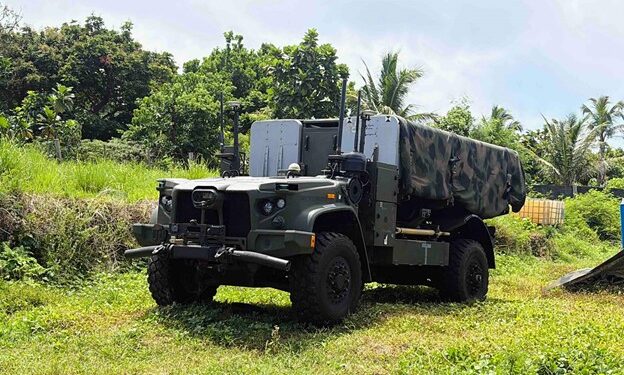
The Balikatan Exercise 2026 participated by the Armed Forces of the Philippines (AFP) and the United States Armed Forces highlighted by the deployment of the United States Marine Corps (USMC) land-based missile system, the Navy-Marine Expeditionary Ship Interdiction System (NMESIS.
The Maritime Key Terrain Security Operations (MKTSO), one of the central activities of the joint military exercise participated by the Philippines, the United States, and partner nations.
The NMESIS missile system is designed to target and deter hostile naval forces, enhance maritime domain awareness, and strengthen the defensive posture of both countries in securing key maritime areas.
According to Staff Sergeant Darren Gibbs, chief of Section 6, Medium Range Missile Battery of the USMC, the NMESIS plays a critical role in shoreline defense operations.
“The NMESIS is an autonomous missile system that is used for shoreline security and sea denial. It’s essentially to help potentially with our straits and sea lines,” Gibbs told defense reporters in Batanes on Saturday, confirming that the system is designed to target ships.
He noted that conducting training in Batanes provides a distinct operational environment for US forces.
“Training out here in Batanes allows us a different environment than what we’re normally allowed to operate in, so it gives us unique opportunities to actually utilize the system and train within our capabilities,” he said. “It also offers us different experiences we normally don’t get offered in our normal day-to-day training.”
Gibbs added that Filipino troops supported the operation by helping secure the area prior to the deployment of the system.
He also detailed the components of the NMESIS, describing it as a compact but capable system composed of a launcher, a mobile command vehicle, and a leader vehicle.
“That is the small group we operate in right now,” he said.
“It’s essentially the system itself and where we do our mission processing and computing of data, and then we have our operating vehicle that allows us to keep it as an autonomous system in itself,” he continued.
Since the system is designed for autonomous operations, it eliminates the need for personnel inside the vehicle.
“The purpose of this system right here is for it to be fully autonomous—for us not to require a driver or a passenger inside the vehicle itself,” Gibbs explained. “We tell it where to go and we program what it needs to do.”
While the system was not fired in Batanes, simulation exercises were carried out in the past few days.
Gibbs clarified that the deployment of the NMESIS in Batanes is temporary and strictly part of the Balikatan Exercise.
“Our normal setup varies on how many Marines we use. Right now, we’re operating with just six Marines,” he said, noting that the system will not be permanently stationed in the province.
Meanwhile, the United States Air Force (USAF) is supporting the movement of key assets for the Balikatan Exercise, including the NMESIS, using C-130J Super Hercules aircraft.
According to Lieutenant Colonel Brendan Wier, commander of the 40th Airlift Squadron of the USAF, airlift operations during the annual drills are focused on transporting heavy equipment across islands.
“In Balikatan, we’re primarily focused on cargo movements. We help the Army and Marines move from island to island with cargo that’s too big for their rotary wing airlift,” Wier told defense reporters.
He said operating in Batanes presents unique challenges for aircrews, particularly at the Basco Airfield.
“Short runways are always a challenge for us. We do train on short runways at home. That’s part of the C-130J mission set. All aircraft commanders and instructor pilots are expected to land on short runways,” Wier said.
“The challenge with Basco Airfield is the upslope, which makes it a single direction airfield. We can only land and take off in one direction, so that becomes a problem when there are different tailwinds, especially coming around the terrain on that island,” he added.
Wier confirmed that both the NMESIS and the High Mobility Artillery Rocket System (HIMARS) have been transported at least four times each as part of the exercise.
“We do move the HIMARS and the NMESIS from place to place to support the Army’s movement,” he said.
Wier also noted that the exfiltration of the NMESIS in Batanes will begin on Saturday, May 2.
“We’re starting the exfil today… for the NMESIS, it’s today throughout the rest of the exercise,” he said.
“We take them. The infil would be to put them on the island. For exfil, we take them out of the island. We do that based on their scheme of maneuvers—when they need to go and when they need to come back,” he explained.
Wier said the missile system will remain in the Philippines after extraction.
The Balikatan 2026 began on April 20 and will run until May 8.