Philippine tourism faces worst since COVID
The Philippine Travel Agencies Association disclosed that Philippine tourism industry is feeling the immediate and unusually complex strain of the geopolitical war between US-Israel and Iran.
PTAA Secretary General, Arnel Gomez, said flights are fewer, fares are higher, and bookings are coming in late than usual, describing it the biggest shock travel after the COVID era… cost-driven, route-driven, and confidence-driven.
Gomez said unlike 2020, when lockdowns shut borders and grounded planes, this slowdown is unfolding while people still want to travel. The problem now is getting them from point A to B — and at a price they’re willing to pay.
A US-Iran war has rippled through global aviation, pushing up jet fuel prices and forcing airlines to cancel or reroute flights. Industry data cited in the interview, referencing the International Air Transport Association, point to roughly one in four flights worldwide being canceled or disrupted — a bottleneck that disproportionately affects long-haul routes to destinations like the Philippines.
On the ground, the slowdown is already visible. During Holy Week — typically one of the busiest travel periods — tourism activity fell sharply, with declines of up to 50 percent in some areas, based on figures discussed on-air.
“We are seeing not a minor disruption… arrivals have dropped”, Gomez said.
He estimates that 60 to 70 percent of the impact is tied directly to fuel costs and flight disruptions, while the rest reflects a shift in traveler behavior — people delaying trips, booking closer to departure, or opting for shorter itineraries.
Despite the pullback, this is not a collapse in interest.
“Tourists still want to come… the challenge is getting from where they are to here in the Philippines”.
That gap between intent and access is where the industry is feeling the squeeze. Fewer direct flights, limited airport capacity, and higher operating costs are combining to make the Philippines harder — and more expensive — to reach.
Fuel has become the biggest cost driver. Surcharges alone can add P600 to as much as P19,000 to a ticket, based on industry estimates cited in the interview.
“Higher fuel prices are now the primary drivers of travel costs”.
The current shock is amplifying weaknesses that were already there.
Even before the latest disruption, the Philippines was trailing its neighbors in tourism recovery. Data from the Department of Tourism show arrivals still below pre-pandemic levels, while countries like Thailand and Vietnam have moved faster to restore routes and ease entry. The Philippine tourist arrivals is about 6.4 million in 2025, versus over 30 million for Thailand and more than 21 million for Vietnam.
“We still have fewer direct international flights… and infrastructure gaps”, Gomez said.
In practical terms, that means longer travel times, higher prices, and more friction for visitors moving between islands.
With costs rising, industry groups are pushing for immediate relief.
“We need immediate action… in connectivity, cost, and coordination”.
That includes reviewing travel taxes, terminal fees, environmental charges, and fuel-related surcharges, along with streamlining visa processing and airport procedures.
“If we make it cheaper… people will still travel”.
The argument is straightforward: demand hasn’t disappeared — it’s being priced out.
At the same time, traveler behavior is changing.
Bookings are happening later. Long-haul trips are being reconsidered. And more travelers are choosing destinations that are closer, simpler, and offer clear value.
“Demand hasn’t disappeared… it’s shifting toward closer, safer, affordable, experience-rich destinations” (15:25–15:37).
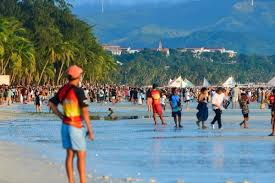
This is where the Philippines still has an edge. Places like Boracay, Palawan, Cebu, Bohol, and Siargao continue to draw interest, especially among travelers looking for beaches, diving, and nature-based experiences. But competition is intensifying across Asia, where countries are offering smoother access and stronger connectivity.
Tourism contributes nearly 20 percent of GDP and supports more than 11 million jobs, according to data cited from global and government sources.
“It’s not just about travel… it’s about protecting livelihoods”.
From tour guides and transport operators to small community businesses, a dip in bookings quickly translates into lost income.
“It will take like half a year or a year… normalization will take time”.
Industry expectations point to a phased recovery: first stabilizing routes and fares, then rebuilding traveler confidence, and only later seeing a full return of arrivals and spending.